Detox
4 min read
November 14, 2022
The lymphatic system

The lymphatic system

The lymphatic system is a vital yet often overlooked network responsible for waste removal, immune defence, fluid balance, and systemic homeostasis. Functioning as the body’s internal drainage and filtration system, it supports nearly every other physiological process—from immunity and detoxification to inflammation control, organ health, and brain function.

What is the Lymphatic System?

The lymphatic system is becoming increasingly more talked about but is still, in my opinion, one of the least appreciated and under-utilised systems in the restoration of movement dysfunctions and chronic health complaints.

Everybody, including health practitioners and those in the fitness industry, could benefit from understanding and implementing lymphatic techniques. You can consider that a homeostatic balance of the internal environment can be a true measure of health.

Lymphatic techniques can, therefore, aid the body in moving towards more of an internal state of homeostasis.
How does the lymphatic system function?

The lymphatic system is, in essence, the sewage system of the body.

It has the incredible ability to trap nearly all soluble antigens, roughly 99%, with its role in waste removal. This is significantly important for the other body systems to not become overwhelmed and develop issues as well.

The lymphatic system contains the thymus, an endocrine organ which is responsible for the development of T-lymphocytes, immune cells that are involved in fighting infection through the process of cell-mediated immunity.

The spleen plays a key role in the lymphatic system as the largest lymphatic organ, having a vital role in a host of detox processes, such as:

  • Filtering blood
  • Removing old dead red blood cells
  • The maturation of lymphocytes and macrophages to aid in fighting infection

The splenic communication of the tenth cranial nerve, the Vagus nerve, is crucial in reducing inflammatory cytokine production.

The tonsils also form part of the structure of the lymphatic system. With the tonsils formed of lymphatic tissue, housing lymphocytes and macrophages, they protect the digestive system and lungs from pathogens entering through the nose or mouth.

There is also a deep association with the gastrointestinal system through gut associated lymphoid tissues (GALT) known as Peyers Patches, with the role of the gastrointestinal system intrinsically linked to the immune system. Estimates suggest that roughly 70-80% of immune function is beholden to gastrointestinal health.

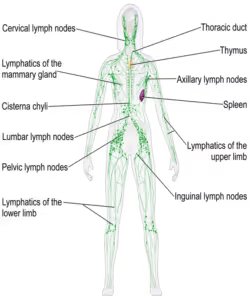
This amazing system also comprises millions of lymphatic vessels which, if placed end to end in a continuous line, would circle the earth four times! Alongside these vessels there are over seven hundred lymph nodes within the body, with the most populated areas being the neck, skin and the intestines.

This mass of lymphatic vessels works in uniform direction towards the heart, with valves interspersed to prevent any backflow from occurring. This one-way system is aided by the structure of the vessels which allow fluids to flow in the direction of clearance, but with numerous valves preventing backflow. Allowing the system to be cleared, very much how a filtration device on a fish tank would work.

The ability to regulate fluid homeostasis is a key aspect of the lymphatic system. The body contains fifteen litres of lymphatic fluid, predominantly of water, and roughly 10% of proteins, hormones and waste products. Comparing this to the five litres of circulating blood that we have, the body wouldn’t contain three times more lymphatic fluid than blood if it wasn’t a critical component of our survival!

From the five litres of circulating blood, over the course of a day, three litres of plasma leaks out into the interstitial space.

If not appropriately removed through the lymphatic system this can lead to swelling outside of the cellular space due to the increased fluid concentration and alterations in pressure.
Without effective drainage this can create stagnation in the fluids;
Let’s go back to the fish tank analogy above, we know that stagnation of fluids is detrimental to the ecosystem, the same being the case for our health.

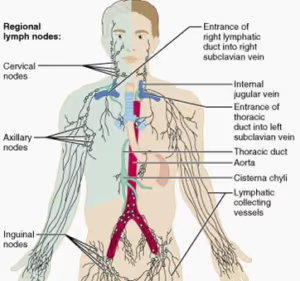
In a system with appropriately functioning lymphatics, this plasma is removed from the interstitial space into the lymphatics system and circulated upwards towards the subclavian vein. This is where it flows into the venous system, before returning to the liver, detoxifying and purifying the blood.

Taking a deeper look into the pathway of the lymphatic vessels will give an understanding into the application of treating the lymphatic system.

As a one way system drains into the venous system at the bilateral sites of the subclavian veins, all lymphatic vessels are required to flow in this direction. The right upper quadrant of the body drains through the right lymphatic duct and into the right subclavian vein, whilst the remainder of the body drains through the thoracic duct into the left subclavian vein.

The thoracic duct is responsible for the majority of lymphatic flow and also houses the largest lymph node, the cisterna chyli, which is a major site of drainage for the liver. It’s crucial to keep this node functioning well as between 25-50% of the returning lymphatic fluid through the thoracic duct is returned from the liver.

There is an important bidirectional relationship between the cisterna chyli and the liver, with an overburdened liver that can’t move or function optimally placing more load on the cisterna chyli. Having a lymphatic system that can’t drain well, especially at the cisterna chyli, increases the potential to create stagnation around the liver. A lymphatic vessel that is unable to drain will not be able to receive fresh supply creating this backlog.

A fairly recent discovery reveals that the lymphatic system also continues up into the central nervous system through the glymphatics, more commonly known as the glymphatic system.

The glymphatic system has the same role as the lymphatic system, however it is only situated in the brain. This helps to reduce inflammation and drive the removal of waste products which is essential for overall brain health. Additionally, the protective benefits of this system helps to distribute fuel sources and various other vital components around the brain.


Next news

The paradigm of depression being a disease/disorder has evolved around the concept that neurotransmitters are primarily the root cause.

Yet, dysregulation in this field could very well be a symptom, coping mechanism and signal from a multitude of different issues ranging from inside, as well as outside of the body (as explained in my previous post).

The association of depression solely being linked to low levels of norepinephrine and serotonin is flawed throughout studies. There are many other variables that can result in this outcome.

Several studies indicate that as few as 25% of depressed patients have low levels of neurotransmitters, while paradoxically, some patients have abnormally high levels of neurotransmitters with no history of them ever being low.

Does the placement of depression into the category of disease/disorder attach a greater overwhelming thought process to the word than if we were to label it as a symptom?

One could argue that generally speaking, symptoms are alleviated with greater ease when compared with the disease.

It is easy to allow our identity to be taken hostage by adopting the ownership of depression and succumb to its depths.

Yet when we shift our thinking to understand that depression does not embody us as individuals, nor does it yield an element involved in modeling our identity, we shift our thoughts to a greater sense of self-empowerment.

We can overcome the ‘depression vs self’ mentality by accepting that depression is an adaptive and protective mechanism from the human body, accompanied with respect for the opportunity it brings forth to gain further insight into what needs nurturing.

I understand this is a challenging and delicate shift to take, yet the perception of the experience is paramount to one’s thoughts.

Could we disempower the shackling chains of emotional paralysis, gain buoyancy in the swamp of thoughts and restore vitality into one’s behaviour when depression is approached in the light of a symptom?

Can we utilise it as foresight with direction to what may require attention and care within our body and how we live?

This paradigm shift allows more of a harmonious level of awareness with the experience of depression and what possibilities it may bring.

References:

  1. Asberg M, et al. Arch Gen Psychiatry. 1976
  2. Mol Psychiatry. 2010 March
  3. Della FP, et al. Pharmacol Biochem Behav. 2012
  4. Della FP, et al. Behav Brain Res. 2012
  5. Della FP, et al. Metab Brain Dis. 2013

Mental Health
6 min read
Depression: disease or symptom?
Viewing depression as a symptom rather than an identity can foster self-empowerment, insight, and more personalised paths to healing—shifting focus from labels to understanding what the body and mind may be asking for attention and care.
December 10, 2022

If you are unfortunate and have had your palatine tonsils removed or have reoccurring infections with your tonsils, this may just help …

The group of tonsils provide:

  • Protection against pathogens and toxins
  • Lymphatic detox
  • Excretion organ
  • One of the greatest immune modulators
  • Supporting the brain's glymphatic system

This last point is massively overlooked, here’s why …

The glymphatic system is essential in mitigating risk against neuro-developmental disorders and degeneration, this ranges from Autism, Alzheimer’s through to some categories of depression.

This system clears the brain during sleep (mostly delta-wave sleep) of harmful proteins (such as amyloid-beta) and waste products by pumping the cerebral spinal fluid through the brain’s tissues. This flushes the waste into the body’s circulatory system in which it eventually reaches the liver where it can be eliminated.

This process is roughly 10 times more active during sleep as opposed to when awake. The brain also shrinks by around 60% of its original size to increase the efficiency of waste removal.

The removal of tonsils will also reduce the efficiency of the immune system, resulting in an increased chance for the development of food intolerances and possibly acting as a contributing factor towards autoimmune diseases (the severity of this risk is not currently quantifiable). If you have had your tonsils removed, there are several options you can do.

In my opinion, here are two of the most important:

  • Massage the intracranial lymph (around the jaw and neck) to improve glymphatic circulation and possibly decrease neuroinflammation
  • Ensure you have a good duration and quality of sleep (promoting delta wave sleep through binaural beats, gratitude logs or specific devices may help)

* The group of tonsils provide direct lymphatic drainage through the cribriform plate to Waldeyer’s Ring – this is a formation of lymphatic tissue situated in and around the:

  • Pharyngeal tonsils (adenoids)
  • Two tubal tonsils (posterior to Eustachian tu)
  • Two palatine tonsils (this is what the tonsils is most commonly referred to)
  • Lingual tonsil (base of tongue)
  • Laryngeal tonsil (near the vocal cords in the larynx)
Gut Health
6 min read
Tonsils – the brain’s drain
Tonsil removal or chronic tonsil infections may reduce immune efficiency and impair glymphatic circulation. Supporting lymphatic flow around the jaw and neck, alongside deep, high-quality sleep, may help compensate and protect long-term brain and immune health.
December 10, 2022

Endometriosis is costing women, and Australia, an estimated total of $9.7 billion per year in medical bills and lost productivity, according to new research.
This equates to an average cost of $30,000 per sufferer per year, both personally and to society.

Around 20–40% of this cost sits directly within the health sector:
– Medications
– Doctor visits
– Assisted reproductive technology (e.g. IVF)
– Transport costs to attend appointments

The remaining 60–80% is due to lost productivity, either from absenteeism or presenteeism—being physically present but unable to perform due to severe pain and discomfort.

Reducing pain caused by endometriosis by just 20% could save Australia billions.

This condition affects more than 830,000 women—over 10% of Australia’s female population.

Symptoms vary widely, contributing to the condition being overlooked or misdiagnosed for 7–12 years, with 1 in 5 doctors missing the diagnosis.
At least 50% of patients experience fertility issues.

Given the scale, one would expect significantly more research, education, awareness, investment, and progress in this field.

Yet many men remain unaware of what endometriosis even is.

This is not necessarily the fault of men.
It is a failure of the system to provide adequate education and visibility.

Women are not being treated with the care, respect, or urgency this condition demands.

It’s time things changed.

Women's Health
6 min read
Endometriosis
Endometriosis
Endometriosis causes chronic pain, fertility challenges, and major productivity loss. Delayed diagnosis and lack of awareness continue to leave women without timely care, demanding urgent systemic change.
December 17, 2022
Clarity, confidence, and real results start with one conversation. Let’s map your next chapter — together.