Gut Health
4 min read
December 10, 2022
H Pylori: 50% globally infected

H Pylori: 50% globally infected

Helicobacter pylori is a highly prevalent gram-negative bacterium that colonises the gastrointestinal tract, including the oral cavity. While often asymptomatic, it is a major driver of chronic gastritis, peptic ulcer disease, impaired nutrient absorption, and increased gastric cancer risk, with wide-ranging systemic effects.

Globally, more than 50% of all people are infected [8], with the prevalence of escalating with age. [9]

Helicobacter Pylori is a gram-negative bacterium that colonises within the human gastrointestinal tract (this includes the mouth).

Symptoms:

  • Belching
  • Nausea
  • Vomiting
  • Difficulty swallowing
  • Abdominal discomfort
  • Upper abdominal bloating
  • Decreased appetite
  • Peptic ulcers
  • Bad breath
  • Heartburn
  • Reoccurring oral plaque
  • Gingivitis
  • Tooth cavities

Risks:

  • H. Pylori infection is the main cause of chronic gastritis, with an infection rate between 80%-95% in sufferers. [7]
  • It is present in almost all cases of duodenal ulcers and most cases of gastric ulcer [10] with as many as 90% of individuals with ulcers being infected.
  • H. Pylori is a significant contributing factor for the risk of gastric cancers.
  • H. Pylori burrows deep within parietal cells (cells that secrete stomach acid), not only does this make it harder to eradicate, but this also leads to unique symptoms within the host. One factor being hypochlorhydria (low levels of stomach acid secreted within the body); this prevents the host from sterilising bacteria in food, reduces the ability to obtain nutrients desired from food and the inability to assimilate certain key minerals, such as zinc or iron.
  • Reduced intrinsic factor (IF) production is also likely for individuals suffering from a H. Pylori infection. IF is essential to bind with vitamin B12, preventing further breakdown from stomach acid along with attaching to the surface of the ileum to allow for absorption of B12 into the body.
  • H. Pylori can also block vitamin C absorption, thus compounding to the amount of oxidative damage inflicted onto the body.
  • H. Pylori infection augments the gastric mucosal damage induced by NSAIDs.
  • H. Pylori antagonises Aspirin-induced delayed ulcer healing due to suppression of acid secretion by the enhancement of PGE2 possibly derived by COX2 expression.
  • Benefits:
    Due to the nature of the parasite being a gram-negative bacteria, it shifts the immune system more towards a Th1 mediated response as opposed to Th2 – this can reduce the severity of allergies, asthma and other humeral/mucosal reactions.

Benefits:

Due to the nature of the parasite being a gram-negative bacteria, it shifts the immune system more towards a Th1 mediated response as opposed to Th2 – this can reduce the severity of allergies, asthma and other humeral/mucosal reactions.

References:

  1. Morales-Espinosa R, et al., Oral Microbiol Immunol. 2009
  2. Nguyen AM, et al., Oral Surg Oral Med Oral Pathol Oral Radiol Endod. 1995
  3. Miyabayashi H, et al., Helicobacter. 2000
  4. Gebara EC, et al., J Clin Periodontol. 2006
  5. Dye BA, et al., Am J Public Health. 2002
  6. Eskandari A, et al. Med Oral Patol Oral Cir Bucal.
  7. Abro AH, et al. J Ayub Med Coll Abbottabad. 2011
  8. Saudi J Gastroenterol. 2014
  9. J Gastrointestin Liver Dis. 2011
  10. J Gastroenterol Hepatol. 2011
  11. Surveillance of Helicobacter pylori antibiotic resistance in England and Wales; Public Health England, 2008
  12. Jernberg, C, et al. 2010

Next news

What is the Lymphatic System?

The lymphatic system is becoming increasingly more talked about but is still, in my opinion, one of the least appreciated and under-utilised systems in the restoration of movement dysfunctions and chronic health complaints.

Everybody, including health practitioners and those in the fitness industry, could benefit from understanding and implementing lymphatic techniques. You can consider that a homeostatic balance of the internal environment can be a true measure of health.

Lymphatic techniques can, therefore, aid the body in moving towards more of an internal state of homeostasis.

How does the lymphatic system function?

The lymphatic system is, in essence, the sewage system of the body.

It has the incredible ability to trap nearly all soluble antigens, roughly 99%, with its role in waste removal. This is significantly important for the other body systems to not become overwhelmed and develop issues as well.

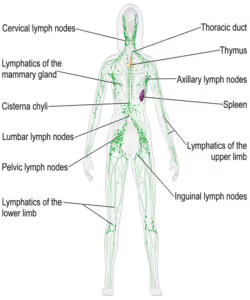
The lymphatic system contains the thymus, an endocrine organ which is responsible for the development of T-lymphocytes, immune cells that are involved in fighting infection through the process of cell-mediated immunity.

The spleen plays a key role in the lymphatic system as the largest lymphatic organ, having a vital role in a host of detox processes, such as:

  • Filtering blood
  • Removing old dead red blood cells
  • The maturation of lymphocytes and macrophages to aid in fighting infection

The splenic communication of the tenth cranial nerve, the Vagus nerve, is crucial in reducing inflammatory cytokine production.

The tonsils also form part of the structure of the lymphatic system. With the tonsils formed of lymphatic tissue, housing lymphocytes and macrophages, they protect the digestive system and lungs from pathogens entering through the nose or mouth.

There is also a deep association with the gastrointestinal system through gut associated lymphoid tissues (GALT) known as Peyers Patches, with the role of the gastrointestinal system intrinsically linked to the immune system. Estimates suggest that roughly 70-80% of immune function is beholden to gastrointestinal health.

This amazing system also comprises millions of lymphatic vessels which, if placed end to end in a continuous line, would circle the earth four times! Alongside these vessels there are over seven hundred lymph nodes within the body, with the most populated areas being the neck, skin and the intestines.

This mass of lymphatic vessels works in uniform direction towards the heart, with valves interspersed to prevent any backflow from occurring. This one-way system is aided by the structure of the vessels which allow fluids to flow in the direction of clearance, but with numerous valves preventing backflow. Allowing the system to be cleared, very much how a filtration device on a fish tank would work.

The ability to regulate fluid homeostasis is a key aspect of the lymphatic system. The body contains fifteen litres of lymphatic fluid, predominantly of water, and roughly 10% of proteins, hormones and waste products. Comparing this to the five litres of circulating blood that we have, the body wouldn’t contain three times more lymphatic fluid than blood if it wasn’t a critical component of our survival!

From the five litres of circulating blood, over the course of a day, three litres of plasma leaks out into the interstitial space.

If not appropriately removed through the lymphatic system this can lead to swelling outside of the cellular space due to the increased fluid concentration and alterations in pressure.

Without effective drainage this can create stagnation in the fluids;
Let’s go back to the fish tank analogy above, we know that stagnation of fluids is detrimental to the ecosystem, the same being the case for our health.

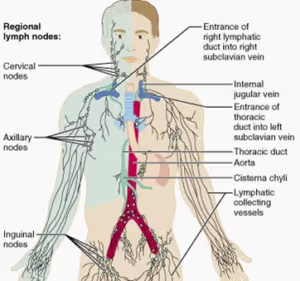
In a system with appropriately functioning lymphatics, this plasma is removed from the interstitial space into the lymphatics system and circulated upwards towards the subclavian vein. This is where it flows into the venous system, before returning to the liver, detoxifying and purifying the blood.

Taking a deeper look into the pathway of the lymphatic vessels will give an understanding into the application of treating the lymphatic system.

As a one way system drains into the venous system at the bilateral sites of the subclavian veins, all lymphatic vessels are required to flow in this direction. The right upper quadrant of the body drains through the right lymphatic duct and into the right subclavian vein, whilst the remainder of the body drains through the thoracic duct into the left subclavian vein.

The thoracic duct is responsible for the majority of lymphatic flow and also houses the largest lymph node, the cisterna chyli, which is a major site of drainage for the liver. It’s crucial to keep this node functioning well as between 25-50% of the returning lymphatic fluid through the thoracic duct is returned from the liver.

There is an important bidirectional relationship between the cisterna chyli and the liver, with an overburdened liver that can’t move or function optimally placing more load on the cisterna chyli. Having a lymphatic system that can’t drain well, especially at the cisterna chyli, increases the potential to create stagnation around the liver. A lymphatic vessel that is unable to drain will not be able to receive fresh supply creating this backlog.

A fairly recent discovery reveals that the lymphatic system also continues up into the central nervous system through the glymphatics, more commonly known as the glymphatic system.

The glymphatic system has the same role as the lymphatic system, however it is only situated in the brain. This helps to reduce inflammation and drive the removal of waste products which is essential for overall brain health. Additionally, the protective benefits of this system helps to distribute fuel sources and various other vital components around the brain.

Detox
6 min read
The lymphatic system
By clearing waste, regulating fluid movement, and supporting immune and neurological health, the lymphatic system plays a central role in resilience and recovery. Optimising lymphatic flow can be a powerful, underutilised tool in addressing chronic health issues and restoring balance within the body.
November 14, 2022

How many of the following symptoms for iron deficiency do you have?

  • Non-Physical Symptoms
  • Anxiety
  • Cognitive dysfunction
  • Dizziness
  • Fatigue
  • Headaches
  • Lowered attention
  • Light-headedness
  • Mood swings
  • Post-partum depression

Physical:

  • Atrophy or enlargement of the taste buds
  • Compromised immune function
  • Hair loss
  • Koilonychia (Brittle, spoon-shaped nails)
  • Leg cramps / heavy legs
  • Lowered body temperature
  • Mouth sores
  • Pale skin complexion
  • Palpitations
  • Poor thyroid function
  • Skin problems
  • Shortness of breath
  • Swollen tongue
  • Restless legs
  • Pregnancy complications

Here are some of the mechanisms behind the above symptoms:

Iron is required for tryptophan hydroxylase activity, this enzyme converts tryptophan to 5HTP, the precursor for serotonin – the chemical brain messenger responsible for our happiness. Therefore with inadequate iron levels, serotonin production will be reduced.

Iron is also needed for tyrosine hydroxylase, this enzyme is essential for the production of dopamine – the chemical brain messenger that is responsible for our drive and motivation.

Iron is essential for the intracellular reception of T3. This reduces the activity of the main thyroid hormone thus lowering metabolism, energy, whilst leading to hair loss and other related factors.

Iron is required to make hemoglobulin. Hemoglobulin helps carry oxygen within the blood to tissues, an integral part of energy production. If iron is low, the body’s ability to produce energy is hindered therefore increasing the likelihood for fatigue. This same mechanism leads to reduced oxygen availability to the brain giving reason as to why headaches are also linked to iron deficiency.

The paling of the skin and inside of the eyelids is due to less hemoglobulin within the blood, as hemoglobulin gives blood its red pigmentation.

Reduced hemoglobulin levels result in less oxygen within the body. As a compensatory mechanism, the body will start to increase breathing and heart rate in hope to get more oxygen, thus leading to a shortness of breath and increased heart palpitations.

Conditions
6 min read
Symptoms of iron deficiency
When iron is low, serotonin, dopamine, thyroid activity, and oxygen delivery are all compromised, contributing to fatigue, mood changes, poor concentration, hair loss, shortness of breath, and cardiovascular strain. Identifying and correcting iron deficiency can be a key step in restoring energy, mental clarity, and overall physiological balance.
December 15, 2022

You are only as ‘strong’ as your weakest link

Our body is a complex yet beautiful organism that we barely scrape the surface when it comes to an understanding of how we work.

What we do know is that every system within our body is interdependent on one another. It works and flows synergistically and has a bidirectional relationship.

We often prioritise aesthetics whilst neglecting other systems, only paying attention to them when it is too late and hardship, dysfunction, or disease has manifested as a consequence.

The following systems are what need respect, nurture, and care:

  • Muscular System
  • Structural
  • Endocrinological
  • Neurological
  • Gastro-Intestinal
  • Microbial
  • Cardiovascular System
  • Pulmonary System
  • Immunological
  • Biotransformation
  • Lymphatic System
  • Psychological
  • Emotional
  • Environmental
  • Spiritual
Philosophy
6 min read
Human symbiosis of health
Focusing on aesthetics while ignoring foundational systems leads to dysfunction over time. True health comes from supporting the body as a whole—physically, mentally, and environmentally.
December 10, 2022
Clarity, confidence, and real results start with one conversation. Let’s map your next chapter — together.